
`
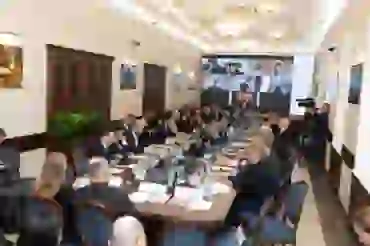
On April 28, 2026, a meeting of the International Council for Cooperation and Investment (ICCI) was held.
During the event, issues of lifting sanctions from the RSPP, expanding the leadership of the ICCI, the possibility of paying dividends, options for returning foreign investors to Russia, the problems of external management of companies and others were discussed.
The meeting, chaired by RSPP President Alexander Shokhin, was attended by: Tadzio Schilling, General Director of the Association of European Businesses (AEB); Robert Agee, President of the American Chamber of Commerce in Russia (AmCham Russia); Matthias Schepp, Chairman of the Board of the Russian-German Chamber of Foreign Trade; Ulf Schneider, Chairman of the AEB, President and Founder of SCHNEIDER GROUP; Alfredo Gozzi, General Director of the Association of Italian Industrialists Confindustria Russia; Vittorio Torrembini, President of the Association of Italian Entrepreneurs in Russia; Hase Naoya, Head of the Moscow Representative Office of the Japanese Business Association ROTOBO; Shiotsuki Shinya, Chairman of the Board of the Japanese Business Club (JBC); Manish Kumar, President of the Soltex Group; Nathan Hunt, Chairman in Moscow of the Canadian Business Association in Russia and Eurasia (CERBA); Oleg Prozorov, General Director and Member of the Board of the Belgian-Luxembourg Chamber of Commerce in Russia (CCBLR); Lubarto Sartoyo, President of the Alliance of Business Structures and Entrepreneurs of Southeast Asian Countries (B2B ASEAN); as well as representatives of the Chinese Committee for the Promotion of International Trade in Russia (CCPIT), the Franco-Russian Chamber of Commerce and Industry and foreign companies operating in Russia.
From federal executive authorities — Dmitry Birichevsky, Director of the Department of Economic Cooperation of the Russian Ministry of Foreign Affairs; Andrey Vorontsov, Director of the Department of Property Relations of the Russian Ministry of Finance; Dmitry Frolov, Deputy Director of the Department of Financial Policy of the Russian Ministry of Finance; Alexey Artemyev, Deputy Head of the Department of Customs Administration of the Department of Customs Policy and Regulation of the Alcohol and Tobacco Markets of the Russian Ministry of Finance; and representatives of the Russian Ministry of Labor.
RSPP President Alexander Shokhin noted that economic realities have changed dramatically in recent years.
«We have passed through the peak of the sanctions shock. Although the 20th package of sanctions of the European Union, of course, shows that creativity still exists. In particular, decisions against Russian companies to which assets are transferred to temporary management appeared precisely in the 20th package,» explained Alexander Shokhin. «Nevertheless, Russian business and the Russian economy have learned to live under sanctions. The center of economic activity is shifting to the Global South and East. Settlements in unfriendly currencies are being replaced by national currencies. The role of technological sovereignty has come to the fore. We believe that the ICCI should consider all these issues.»
The head of the RSPP added that there is a need to bring the composition of the ICCI leadership in line with new economic realities. A balance is needed that reflects the real map of Russia’s business partners — not only traditional associations from Europe and the US, but also powerful business associations from the BRICS countries (China, India, Brazil), the Middle East, Central Asia, Africa and Latin America. It is necessary to involve co-chairs who represent growing markets, where the main investment flows and growth points are concentrated today.
Alexander Shokhin proposed including Manish Kumar, President of the Soltex Group, among the co-chairs of the ICCI.
«Until now, our Council has more often responded to requests from foreign business,» said the head of the RSPP. «We propose to include in the agenda the issues of Russian companies’ work in foreign markets. We consider the ICCI as the main platform for developing proposals for the country’s leadership on issues of interest to Russian and foreign business in Russia.»
AEB General Director Tadzio Schilling noted that lifting sanctions from the Russian Union of Industrialists and Entrepreneurs would be a pragmatic step.
«Lifting restrictions on the RSPP and on you personally (Alexander Shokhin — ed. note) would, in our opinion, be a pragmatic step that would allow returning to full-format work without touching, by the way, the political issue, but a purely economic issue. This decision will be perceived by European business as a positive signal of readiness to restore normal business dialogue,» said Tadzio Schilling, adding that any restrictions against associations such as the RSPP hinder international dialogue.
AmCham Russia President Robert Agee confirmed the intention of the American Chamber of Commerce in Russia to appeal to the US authorities with a proposal for a temporary suspension of sanctions against the RSPP for the period of preparation and holding of the Business Twenty (B20) summit. Thus he supported the initiative proposed by the head of the RSPP. «If we look at a temporary license for the RSPP for the period of preparation and holding of the Business Twenty (B20), then, probably, it is the American Chamber of Commerce that could come forward with this,» said Alexander Shokhin. In response, Robert Agee said: «This is a good idea. We will definitely raise this issue. And once again I suggest, if you have time before SPIEF, let’s arrange a meeting with people from the State Department here in Moscow.»
In addition, AmCham Russia has prepared a proposal to regulate the procedure for transferring foreigners’ assets to temporary management.
Alexander Shokhin noted that the RSPP is ready to support this proposal if «we are talking about generalizing practice and proposing on our part to adjust certain points that will increase the effectiveness of this procedure both from the point of view of understanding by business and preserving assets as effective and working.»
«When a temporary manager is appointed, there is also some selection procedure, some qualification requirements should be imposed,» he said. This would help avoid, in particular, situations where a manager unknown to the business community «registered only yesterday and today manages some assets.»
Alexander Shokhin emphasized that «transferring an asset to temporary management does not always solve all problems.» As an example, he cited pharmaceutical companies, regarding which there is currently a discussion about transferring the results of intellectual activity to temporary management, «so as not to waste time through the compulsory licensing scheme.»
The head of the RSPP noted that there are good examples when a management company contributes to the development of an asset, and even the former owner is ready to interact with it in order to help preserve the enterprise in working condition. «But there are examples when the management company fails,» he added.
The institution of the Presidential Commissioner for the Protection of Entrepreneurs’ Rights could be involved in improving the transparency of procedures related to the introduction of temporary management, added Alexander Shokhin. The RSPP expects to agree with the Administration of the Head of State on the format for resuming the work of this institution before SPIEF.
Dmitry Birichevsky, Director of the Department of Economic Cooperation of the Russian Ministry of Foreign Affairs, said that in response to the 20th package of EU sanctions, Moscow is developing economic instruments. Earlier, the European Union introduced new restrictions concerning the exploration, production, processing and transportation of Russian oil as part of the 20th package of anti-Russian sanctions.
«We are studying economic measures that will help strengthen sovereignty, support domestic producers and create competition for those producers to whom we restrict access to the Russian market, so that our producers find themselves in a more advantageous position,» noted Dmitry Birichevsky.
He added that the development of targeted economic measures is handled by the Commission on Reducing Barriers in Foreign Trade. At the same time, the Ministry of Foreign Affairs and the Government take into account that retaliatory measures should not negatively affect their own economy.
Continuing the meeting, AEB General Director Tadzio Schilling spoke about the unjustified inclusion of dividends in the customs value. «Even if we allow the interpretation of this norm such that inclusion is possible, there is no certainty in it so that business understands when this needs to be done and when not. In essence, dividends are an economic value that is determined only ex post. Based on the results of certain economic activities, participants understand that they earned profit and want to distribute it or not distribute it,» said Tadzio Schilling, specifying that in some cases the inclusion of dividends in the customs value leads to double taxation.
Alexey Artemyev, Deputy Head of the Department of Customs Administration of the Department of Customs Policy and Regulation of the Alcohol and Tobacco Markets of the Russian Ministry of Finance, cited the position of the agency according to which dividends are not included in the customs value of imported goods if they are not related to direct economic relations between the buyer and seller within the framework of a specific transaction.
After the emergence of judicial practice and Supreme Court decisions, the Russian Ministry of Finance issued a clarification in which it tried to systematize the approaches of the courts. The emphasis is on whether goods are sold in market conditions (i.e., whether they can be purchased by buyers who are not shareholders). Alexey Artemyev emphasized that the Supreme Court’s methodology on this issue may contain contradictions, and the ministry is working to form a unified, methodologically justified approach.
President of the Soltex Group Manish Kumar proposed several ideas to simplify the system of attracting highly qualified specialists (HQS) in order to make this process more efficient and less costly for business.
In his opinion, against the backdrop of establishing high requirements for the salaries of specialists (which increases company costs), it is also worth introducing a mechanism for confirming real qualifications — for example, through verification of diplomas and certification of employees.
«Retraining of foreign specialists in Russia is necessary. A commission is needed that would confirm that they are highly qualified employees,» said Manish Kumar, specifying that it is necessary to define employees as highly qualified based on their skills and competencies, and not only on the basis of their income level. Such an approach will help attract talent to Russia without creating an excessive financial filter for them.
Summing up the meeting, RSPP President Alexander Shokhin noted that all the proposals voiced will find their practical implementation. He also proposed making ICCI meetings more regular, including in the format of operational working meetings.
The International Council for Cooperation and Investment (ICCI) is an advisory body established by the Russian Union of Industrialists and Entrepreneurs in 2008 as a platform for dialogue between foreign business and Russian authorities. The ICCI unites leading foreign investors in the Russian economy, business associations and chambers of commerce and industry.
The ICCI is headed by RSPP President A.N. Shokhin; the co-chairs of the ICCI are the Head of the RSPP Committee on International Cooperation V.F. Vekselberg, as well as the leaders of country foreign business associations: the President of the American Chamber of Commerce in Russia, the Chairman of the Board of the Association of European Businesses in the Russian Federation, the Head of the Japanese Business Club, the Chairman of the Russian-German Chamber of Foreign Trade, and the General Director of the French Chamber of Commerce and Industry in Russia.
`